
When production floors experience unexpected downtime, rising defect rates, and spiraling operational costs, standard adjustments rarely provide permanent solutions. At Incito, we recognize that true operational health requires a systematic, data-driven approach.
We leverage lean six sigma manufacturing methodologies to isolate the root causes of process variability and material waste, transforming complex factory environments into streamlined engines of profitability.
By blending the waste-elimination power of lean manufacturing principles with the defect-reduction precision of six sigma manufacturing, our team helps leadership teams systematically map workflows, identify hidden bottlenecks, and implement sustainable manufacturing process improvement. We ensure your organization achieves lasting production optimization by converting tribal knowledge into quantifiable, standardized success. Whether you are battling machine idling, excessive material handling, or assembly line scrap, our tailored intervention aligns your organizational culture with operational excellence to secure long-term profitability.

The Convergence of Lean and Six Sigma in Manufacturing
In our extensive work with global manufacturers, we frequently encounter organizations that treat Lean and Six Sigma as entirely separate, competing philosophies. This siloed approach limits your operational potential. To truly transform a production environment, you must understand how these two methodologies complement one another to form a unified strategy.
Lean manufacturing principles focus heavily on speed, flow, and the relentless elimination of waste, known traditionally as muda. Lean views any activity that does not add direct value from the perspective of the end customer as a target for elimination. This includes the traditional eight wastes: overproduction, waiting, unnecessary transportation, inappropriate processing, excess inventory, unnecessary motion, defects, and underutilized talent.
Conversely, six sigma manufacturing addresses the hidden enemy of efficiency: process variability. Developed as a highly disciplined, statistical approach, Six Sigma seeks to stabilize processes so that output is completely predictable. By measuring the standard deviation of a process, Six Sigma aims to keep defects to an absolute minimum, specifically fewer than 3.4 defects per million opportunities.
When we integrate these two disciplines into lean six sigma manufacturing, we equip your team with a balanced toolkit. Lean creates a clear, unobstructed path for materials and information, while Six Sigma ensures that every step along that path executes with flawless consistency. The result is a comprehensive strategy for manufacturing process improvement that reduces lead times, improves quality, and lowers overall operational costs.
The Core Framework: Driving Change with the DMAIC Methodology
To achieve genuine production optimization, organizations cannot rely on guesswork or superficial adjustments. We utilize the structured DMAIC methodology to guide every improvement initiative. This five-phase roadmap provides a rigorous framework for isolating problems, implementing solutions, and locking in the gains over the long term.
Define the Scope and Value
The initial phase requires a precise understanding of the operational problem. We work with your project sponsors to build a comprehensive Project Charter. This document identifies the specific boundaries of the process, establishes the Voice of the Customer (VOC), and quantifies the financial impact of the current inefficiency. Without a clearly defined scope, improvement projects risk scope creep and misaligned organizational priorities.
Measure Baseline Performance
During the measure phase, we transition from qualitative observations to cold, hard data. Your teams gather baseline performance metrics to understand exactly how the process behaves today. Key performance indicators during this stage often include:
- Cycle Time: The total time required to complete a single specific operation from start to finish.
- Takt Time: The precise rate at which a product must be completed to satisfy ongoing customer demand.
- First Pass Yield (FPY): The percentage of products that pass through a process step correctly without requiring any rework or scraping.
- Defect Parts Per Million (PPM): A normalized metric tracking exactly how many defective units occur across a million opportunities.
Analyze the Data for Root Causes
Once we establish an accurate baseline, the analysis phase focuses on identifying the true root causes of waste and variability. Rather than reacting to visible symptoms, your team utilizes analytical tools such as the Ishikawa (Fishbone) diagram, the 5 Whys technique, and Failure Mode and Effects Analysis (FMEA). This step separates random process noise from systemic flaws, ensuring that your future investments target the actual source of the disruption.
Improve Process Flow
With the root causes identified, the improvement phase focuses on designing, testing, and implementing targeted solutions. We assist your teams in deploying specific lean tools to eliminate waste and stabilize workflows. This may involve implementing 5S workplace organization, creating cellular manufacturing layouts to minimize motion, or designing Poka-Yoke (mistake-proofing) devices to prevent defects from moving downstream.
Control and Sustain the Gains
The final, and arguably most critical, phase is control. Many organizations experience a temporary performance boost during an improvement project, only to see the process degrade months later. To prevent this, we help you establish Standard Work protocols, launch visual management systems, and utilize Statistical Process Control (SPC) charts. These tools allow your frontline supervisors to monitor process health in real time and take immediate corrective action before a minor deviation becomes an expensive crisis.
Request a Complimentary Consultation
Incito can help you understand areas of improvement and the steps to get there.
Real-World Manufacturing Challenges: Targeting Root Causes on the Production Floor
To appreciate the impact of lean six sigma manufacturing, we must examine how these principles apply to the daily friction found on the factory floor. Let us explore three critical areas where waste and variability frequently erode manufacturing margins.
Eradicating Unscheduled Machine Downtime
Unscheduled downtime is a massive driver of operational waste. When a primary piece of machinery fails unexpectedly, the entire upstream and downstream flow grinds to a halt. Operators sit idle, inventory accumulates in work-in-progress (WIP) staging areas, and delivery schedules face severe jeopardy.
Through a targeted manufacturing process improvement initiative, we help organizations move away from reactive maintenance patterns. By analyzing equipment failure data, your engineering teams can identify the specific components driving breakdown frequency. We then implement a Total Productive Maintenance (TPM) framework alongside Single-Minute Exchange of Die (SMED) techniques. This reduces setup durations and creates predictable, structured maintenance windows, directly boosting your Overall Equipment Effectiveness (OEE).
Reducing Defect Rates and Scrap Material
Material scrap is a direct hit to your bottom line. Every defective part represents wasted raw materials, squandered machine capacity, and misallocated labor hours. If a defect manages to escape the facility and reach the customer, the costs multiply exponentially via warranty claims, shipping penalties, and severe brand damage.
By applying six sigma manufacturing principles, we look closely at the inputs causing process variation. For example, in an injection molding operation, variability in barrel temperature or clamping pressure can cause parts to warp. By utilizing Design of Experiments (DOE), we determine the optimal operating parameters and establish strict control limits. This drastically reduces scrap rates and ensures that your production lines achieve high first-pass yields.
Optimizing Material Handling and Transportation Waste
Every time a component is moved, lifted, or restaged on the production floor, your operation incurs cost without adding any value to the product. Excessive material handling typically points to a poorly designed plant layout, uncoordinated scheduling, or inflated batch sizes that clog warehouse corridors.
Our consultants work with your teams to map material flows using Spaghetti Diagrams and Value Stream Maps. By transitioning from large-batch push production to a synchronized pull system driven by Kanban signals, we minimize inventory footprints. Redesigning lines into U-shaped manufacturing cells ensures that parts move seamlessly from one value-adding step to the next with minimal human intervention.
| Manufacturing Challenge | Lean Six Sigma Countermeasure | Primary Operational Benefit |
| High Setup Times & Changeover Delays |
SMED (Single-Minute Exchange of Die) |
Increased Machine Flexibility & Reduced Batch Sizes |
| Uncontrolled Process Variation | Statistical Process Control (SPC) Charts |
Early Defect Detection & Consistent Product Quality |
| Disorganized Workstations & Wasted Motion |
5S Workplace Organization | Improved Operator Safety & Enhanced Productivity |
| Bloated WIP Inventory & Bottlenecks |
Kanban Pull Systems | Balanced Process Flow & Reduced Lead Times |
Operational Spotlight: Turning Chaos into Consistency
Consider a precision automotive component manufacturer experiencing severe margin erosion. The facility faced a compounding crisis: their primary assembly line suffered from an average first-pass yield of just 88%, while unexpected equipment breakdowns caused more than 40 hours of unscheduled downtime each month. Emergency production runs and air-freight shipping fees were destroying their profitability.
We guided their cross-functional team through a rigorous Lean Six Sigma deployment. By mapping the end-to-end value stream, the team discovered that variations in component alignment during a critical fastening step were causing the defects. They implemented a simple, mechanical Poka-Yoke device that made improper alignment physically impossible. Simultaneously, they restructured their maintenance protocol into a predictive TPM schedule.
Strategic Deployment for Production Optimization
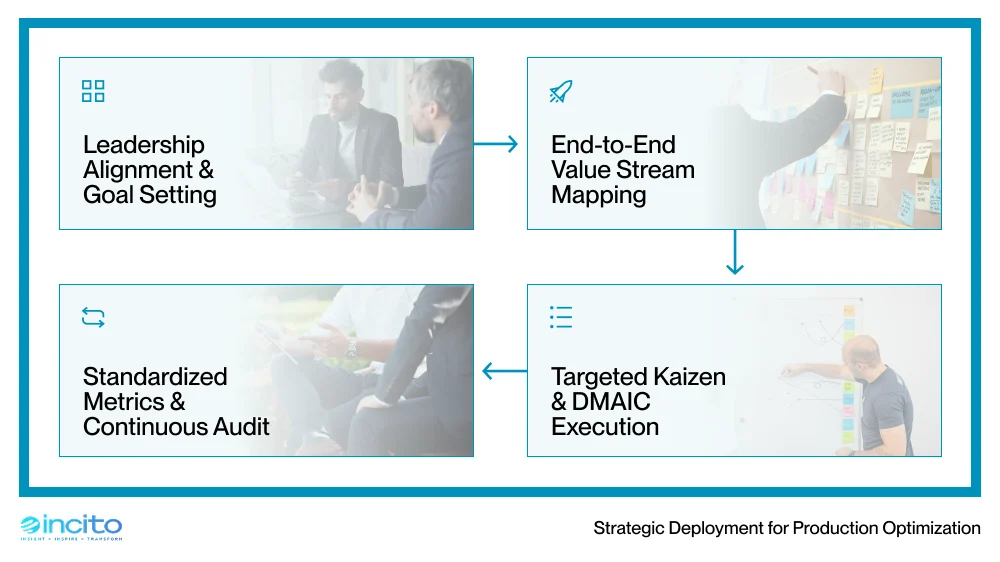
Embarking on a journey toward production optimization requires a deliberate, structured deployment model. You cannot simply train a few individuals in statistical tools and expect an immediate cultural shift. True transformation requires an overarching strategy that connects high-level business goals directly to execution on the shop floor.
1. Establish True North Alignment
Before launching any tactical projects, senior leadership must define the organization’s strategic priorities, a concept we refer to as True North. We work alongside your executive team to align corporate metrics with operational realities. This ensures that every Lean Six Sigma project selected actively supports your broader financial, quality, and delivery goals.
2. Conduct Enterprise Value Stream Mapping
With strategic priorities established, we map the entire current state of your operations. An Enterprise Value Stream Map allows everyone to visualize how materials and information move through your facility. This eye-opening exercise clearly highlights where value is created and where waste accumulates, providing a data-driven roadmap for launching your initial improvement events.
3. Execute Focused Kaizen Events
Transformation requires decisive action. We lead your cross-functional teams through intensive, highly focused Kaizen events designed to solve specific operational bottlenecks. These events bring together operators, engineers, and managers to analyze a targeted area, design improvements, and implement changes over a compressed timeframe. This rapid execution builds immediate organizational momentum and demonstrates the concrete value of the methodology.
4. Monitor Quantifiable Financial and Operational Metrics
To ensure the long-term viability of your improvements, your organization must establish transparent, visual tracking mechanisms. We help you implement daily management systems that review operational performance at every shift change. By tracking variance against standard work in real time, your organization creates an environment where problems are surfaced immediately and solved permanently.

Beyond the Tools: Building a Culture of Operational Excellence
It is a common pitfall to view lean six sigma manufacturing merely as an array of technical tools, such as control charts, matrices, and diagrams. If your deployment focuses exclusively on mechanics while ignoring the human element, your process improvements will eventually fail. Sustained production optimization relies entirely on cultural transformation.
At Incito, we believe that true operational excellence occurs when every employee, from the executive suite to the front-line assembly operator, is actively engaged in problem-solving every single day. This requires a profound shift in leadership behavior. Managers must transition from traditional top-down directors into supportive coaches who frequent the gemba, the actual place where work is performed, to understand realities and remove obstacles.
When you invest in developing your people and fostering a mindset of continuous improvement, your production floor shifts from a reactive state of fire-fighting to a proactive culture of innovation. Employees begin to take deep ownership of their work zones, identify inefficiencies before they impact quality, and consistently look for ways to optimize flow. This cultural foundation is what separates companies that merely run occasional projects from those that achieve world-class operational performance.
Frequently Asked Questions
Lean focuses primarily on maximizing velocity and efficiency by eliminating non-value-added activities and process waste. Six Sigma focuses on improving quality and predictability by using statistical tools to reduce process variation and eliminate defects. Combined, they address both the speed and the quality of your production lines.
While a comprehensive corporate transformation takes time, targeted tactical results can be realized quickly. A well-executed Kaizen event focused on a specific production bottleneck can yield significant waste reduction, cycle time improvements, and cost savings within a single week. Broader DMAIC projects targeting complex process variations typically conclude within three to five months.
Yes. While early applications of these methodologies focused on high-volume automotive lines, the core principles are highly effective in high-mix, low-volume environments. In these settings, we focus heavily on reducing setup and changeover times, standardizing flexible work cells, and streamlining the flow of information to ensure the operation can adapt to changing customer specifications without incurring excessive waste.
We address resistance by involving your frontline team members directly in the improvement process from day one. We do not impose solutions from the outside. Instead, our consultants work side-by-side with your operators during Value Stream Mapping and Kaizen events. By empowering your team to identify problems and design their own future workflows, we build immediate ownership and eliminate the friction often caused by top-down corporate mandates.
Maximize Efficiency on Your Production Floor
Achieving sustainable manufacturing process improvement requires more than just standard training manuals or isolated projects. It requires an experienced strategic partner who understands how to blend data-driven methodologies with meaningful cultural change. At Incito Consulting Group, our seasoned lean six sigma experts bring decades of real-world manufacturing experience to help you eliminate waste, stabilize your operations, and significantly protect your margins.
Ready to eliminate waste and optimize your production floor? Contact Incito Consulting today to schedule a strategic consultation with our lean six sigma experts.
Want to learn more?
Schedule a consultation.
About how Incito can help transform your business and tackle your most
important strategic challenges.