
In the high-stakes world of global enterprise, continuous improvement is often dismissed as a corporate catchphrase. Executives are frequently bombarded with promises of “transformation,” yet they are left asking one critical question: What is the actual return on investment (ROI)?
At Incito, we believe that if you can’t measure it, you can’t manage it, and you certainly can’t justify it. When considering Lean Six Sigma consulting, the focus shouldn’t just be on the methodology, but on the measurable outcomes that hit your P&L. Whether you are navigating supply chain disruptions or looking to scale with Fortune 100 discipline, understanding the real numbers behind Lean Six Sigma ROI is the first step toward achieving operational excellence.

Beyond the Buzzwords: Why Measurable Results Matter
Lean Six Sigma is the combination of Lean’s waste-reduction speed and Six Sigma’s defect-reduction precision. While the “how” involves complex statistical tools and Value Stream Mapping (VSM), the “why” is simple: profitability.
The hesitation to engage in consulting often stems from the perceived “soft” nature of the benefits. However, a structured LSS deployment is anything but soft. It is a scientific, data-driven approach designed to address three core pillars of business health:
- Cost Reduction (Direct and Indirect)
- Quality Improvement (Eliminating the Cost of Poor Quality)
- Cycle Time (Velocity and Efficiency)
1. Cost Reduction: Identifying the “Hidden Factory”
One of the most immediate Six Sigma benefits is the identification and elimination of the “hidden factory,” the portion of your capacity that exists solely to fix mistakes, redo work, or manage unnecessary inventory.
Hard Savings vs. Soft Savings
When calculating continuous improvement ROI, it is essential to distinguish between these two:
- Hard Savings: These are direct impacts on the bottom line. Examples include reduced headcount requirements through automation, lower raw material waste, and decreased energy consumption. Industry benchmarks suggest that a mature Lean Six Sigma project can yield between $50,000 and $250,000 in hard savings per project.
- Soft Savings: Cost-avoidance measures. For example, by improving a process, you might avoid hiring additional staff as the company grows. While harder to track on a balance sheet, they are vital for long-term scalability.
The Real Numbers: On average, organizations that commit to a full-scale Lean Six Sigma transformation see an ROI ranging from 4:1 to 7:1 within the first 12–18 months. For every dollar spent on consulting and training, they reclaim four to seven dollars in recovered waste and efficiency.
2. The Quality Equation: Reducing the Cost of Poor Quality (COPQ)
Quality isn’t just about customer satisfaction; it’s about the massive financial drain known as the Cost of Poor Quality (COPQ). COPQ typically consumes 15% to 40% of total revenue in organizations without a rigorous quality framework.
Defects Per Million Opportunities (DPMO)
Six Sigma’s goal is to achieve 3.4 defects per million opportunities. While “perfection” is the target, the journey toward it provides massive financial relief.
- A 3-Sigma Company (approx. 66,800 defects per million) spends significantly on warranties, returns, and customer service.
- A 6-Sigma Company (3.4 defects per million) virtually eliminates these costs.
The Real Numbers: By reducing defect rates from 10% to 1%, a mid-sized manufacturing plant can realize an annual benefit of $1.5M to $3M, depending on the product’s unit cost. This isn’t just a theoretical gain; it represents actual cash that stays in the business rather than being refunded to dissatisfied customers.
3. Cycle Time: The Velocity of Value
In a world defined by lightning-fast expectations, time is a currency. Six Sigma results often manifest as a dramatic reduction in cycle time, or the time it takes to convert a customer order into cash.
Process Cycle Efficiency (PCE)
Lean practitioners use PCE to measure how much of a process adds value to the customer. In most non-Lean environments, value-added time is often less than 5% of the total lead time. The rest is waste (waiting, moving, over-processing).
The Real Numbers: By applying Incito’s Enterprise Value Stream Mapping (VSM), we have seen clients reduce lead times by 30% to 60%. This velocity allows for:
- Faster billing cycles (improving cash flow).
- Lower inventory holding costs (freeing up working capital).
- Higher throughput without adding shifts or equipment.
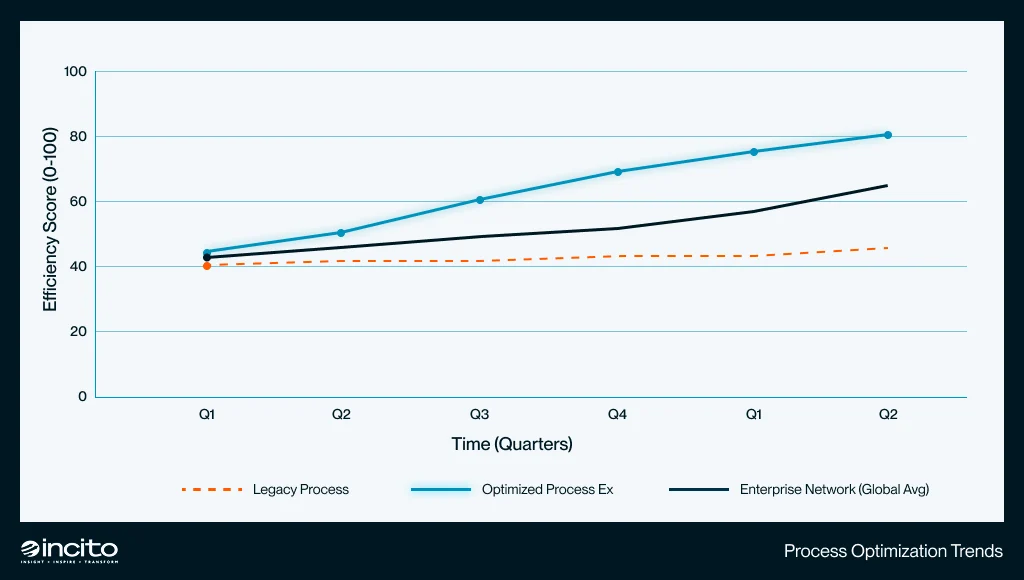
Calculating Your ROI: The Incito Approach to Value Creation
At Incito, we don’t just hand over a report; we embed ourselves in your culture to drive results. Our 5-step deployment model: Foundation, Analysis, Coaching, Deployment, and Sustainment – is designed to ensure the ROI isn’t a one-time spike, but a permanent shift in the baseline.
The ROI Formula
To estimate your potential Lean Six Sigma ROI, consider this simplified model:
ROI = (Total Financial Benefits – Total Cost of Implementation) / Total Cost of Implementation
Where “Total Benefits” include:
- Reduced Scrap/Rework
- Inventory Reduction
- Labor Productivity Gains
- Avoided Capital Expenditures
The Real Numbers: For a typical $100M revenue company, a focused 12-month LSS engagement often identifies $2M to $5M in annualized savings. Compared with the investment in a specialized consulting team, the payback period is often less than 6 months.
Request a Complimentary Consultation
Incito can help you understand areas of improvement and the steps to get there.
Why Cultural Transformation is the Ultimate ROI Multiplier
Numbers are the “what,” but culture is the “how.” The reason many Lean Six Sigma initiatives fail is that they focus solely on the tools (the “hard” side) without addressing the “soft” side, leadership, and mindset.
Incito’s methodology is rooted in the Toyota Production System. We believe the highest ROI comes from a “True North” alignment where every employee, from the Gemba to the C-Suite, is a problem solver.
- Employee Engagement: High engagement reduces turnover costs (which can be 1.5x to 2x an employee’s salary).
- Knowledge Transfer: Our goal is to work ourselves out of a job by training your team to become Lean experts. This creates an “infinite ROI” where the savings continue long after the consultants have left.
Addressing the Cost-Benefit Concern: Is it Worth It?
A common objection we hear is: “We can’t afford the consulting fees right now.”
The reality, based on the numbers above, is that most companies are already paying for Lean Six Sigma consulting; they just aren’t getting the benefits. They are paying for it in the form of scrap, lost customers, and inefficient processes that burn through cash daily.
By partnering with a firm that understands the nuances of your specific industry, be it Healthcare, CPG, Aerospace, Defense, or Retail, you aren’t just “buying a project.” You are investing in a structured roadmap to a more profitable, agile future.

Ready to Define Your True North?
The data is clear: Lean Six Sigma isn’t a cost; it’s a value-generating engine. If your organization is ready to stop guessing and start measuring, the “real numbers” are waiting for you.
The Incito Way is built on the belief that your business has untapped potential hidden within its current processes. We provide the insight, tools, and hands-on coaching to unlock that potential and deliver ROI that justifies the journey.
Key Takeaways for the C-Suite:
- LSS ROI typically ranges from 4:1 to 7:1.
- Cycle time reduction of 30%+ is a standard benchmark for Lean enterprises.
- Quality improvements can reclaim up to 20% of lost revenue.
- Cultural alignment ensures these gains are sustainable for decades, not just quarters.
Are you ready to see what your real numbers look like?
Contact Incito Consulting Group today to schedule an assessment and begin your journey toward lasting excellence.
Want to learn more?
Schedule a consultation.
About how Incito can help transform your business and tackle your most
important strategic challenges.